




Vital Transformation is a small, unique consultancy focused on addressing the challenges of today’s modern healthcare system. We partner with your organisation to help you find answers to hard to solve problems.
Contact us to learn how Vital Transformation can help your organisation.
LATEST RESEARCH

Antimicrobial Resistance (AMR) Project
- Antimicrobial resistance (AMR) increases healthcare costs, hospital stays, and readmission rates, creating a growing economic burden on the U.S. healthcare system.
- Based on a cohort of 50,189 patients, with 13% experiencing AMR infections, the following impacts were observed:
- An additional 4 days of hospitalization per AMR infection.
- An additional $21,453 in direct medical costs per AMR infection.
- A 28% hospital readmission rate for AMR patients, compared to 21% for non-AMR patients.
- AMR is estimated to cost the U.S. $31 billion annually in 2025, increasing to $52 billion by 2045.
- The projected 20-year economic burden of AMR in the U.S. is $655 billion in net present value.
LATEST COMMUNICATIONS

Our Communication Services

In this episode of the Vital Health Podcast, host Duane Schulthess speaks with Eric Lindquist, biotech entrepreneur and former Chief Business and Commercial Officer at Celcuity, about the 2021 deal to license gedatolisib from Pfizer.
Drawing on Lindquist’s experience with the transaction, they explore portfolio fit, the responsibilities of advancing a medicine, and how funding, pricing policy, and international competition shape drug development and patient access.
MORE RESEARCH

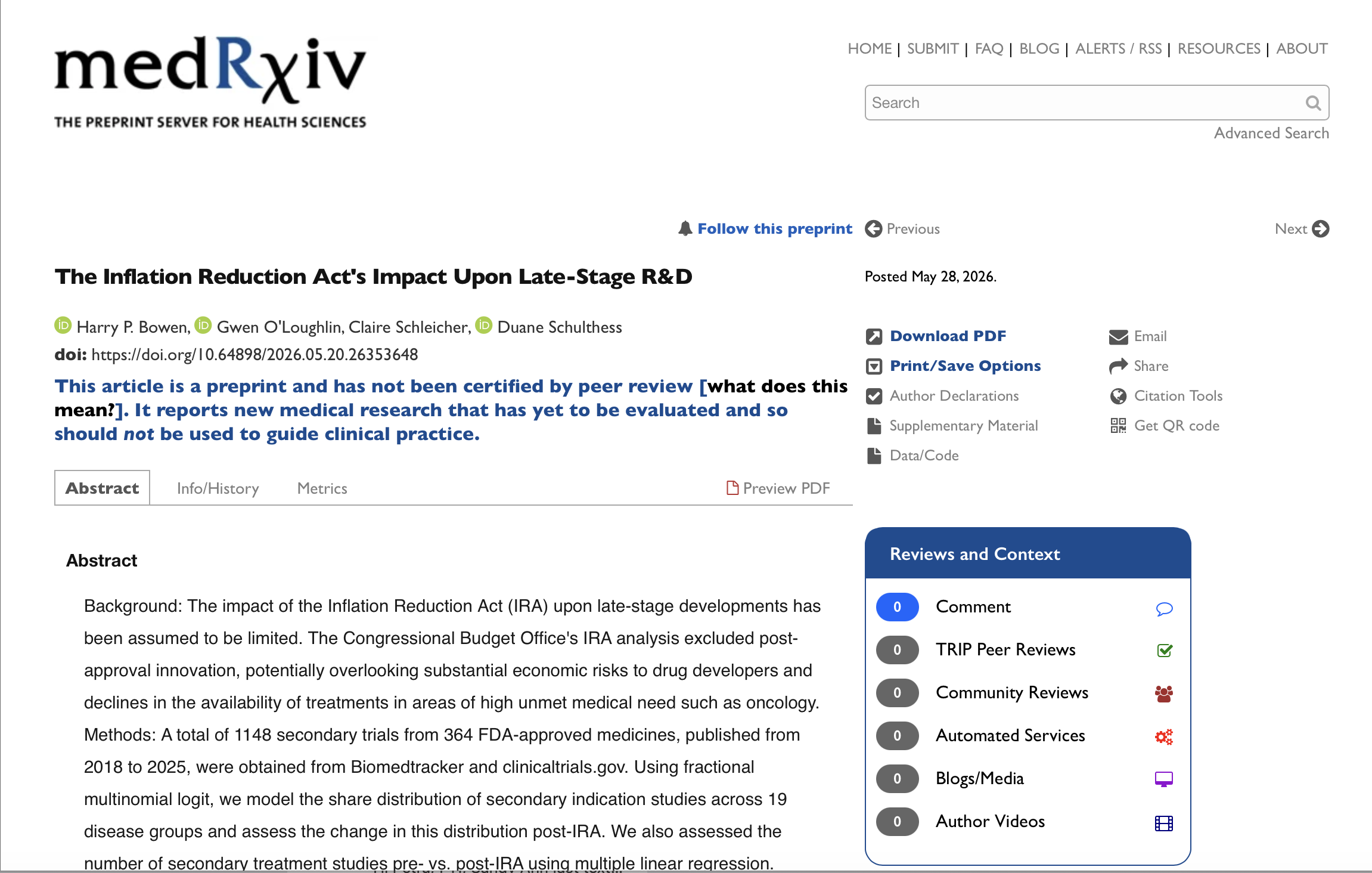
PREPRINT NEW RESEARCH: The Inflation Reduction Act’s Impact Upon Late-Stage R&D
Vital Transformation is preparing a new analysis with a total of 1148 secondary trials from 364 FDA-approved medicines, published from 2018 to 2025, obtained from Biomedtracker and clinicaltrials.gov. Using fractional multinomial logit, we model the share distribution of secondary indication studies across 19 disease groups and assess the change in this distribution post-IRA. We also assessed the number of secondary treatment studies pre- vs. post-IRA using multiple linear regression.

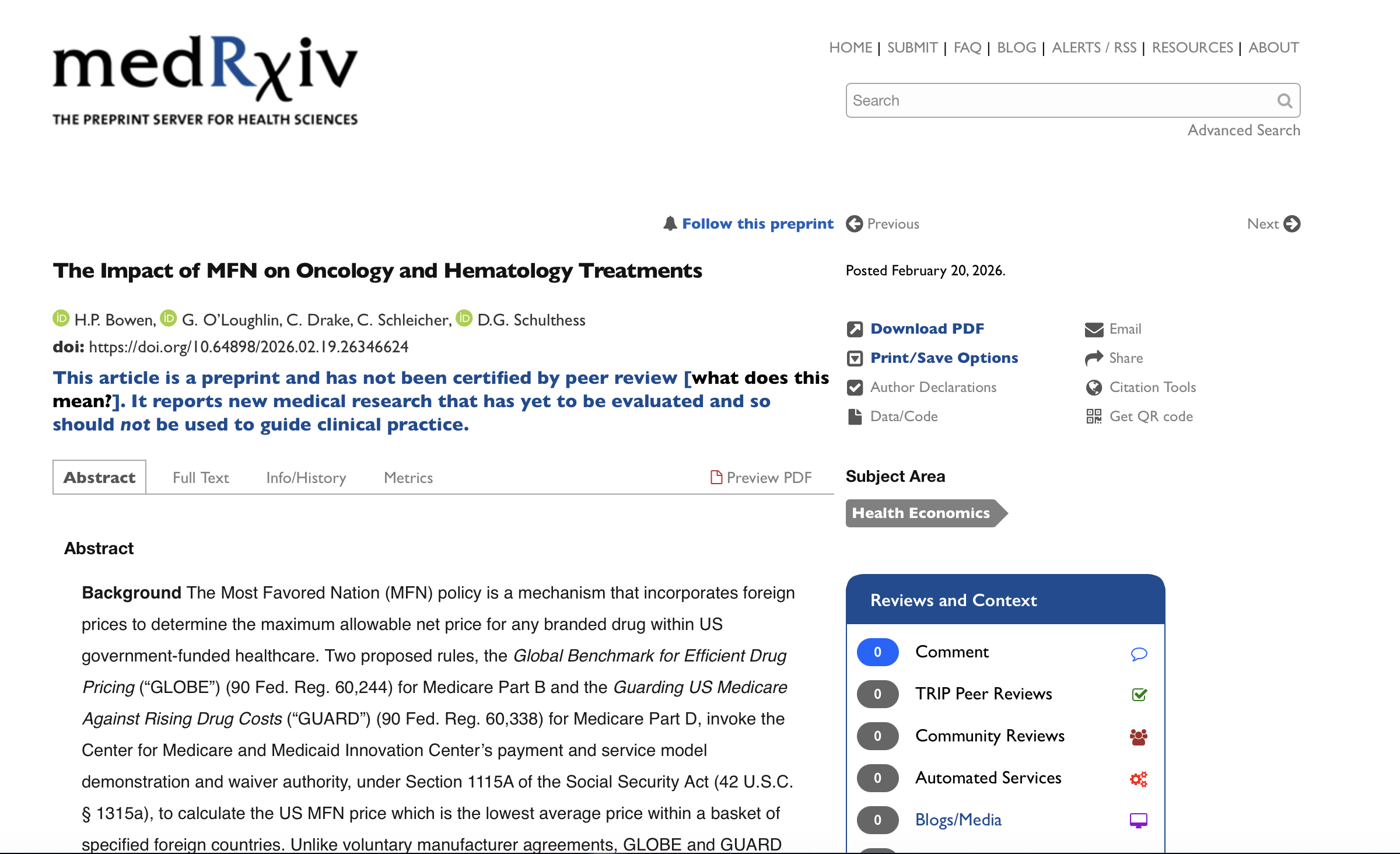
PREPRINT NEW RESEARCH: The Impact of MFN on Oncology and Hematology Treatments
Vital Transformation is preparing a new analysis about the potential implications of Most Favored Nation (MFN) drug pricing policies for the U.S. oncology ecosystem, focusing on how international reference pricing could reshape provider economics, patient access, and innovation incentives. The analysis models the effect of benchmarking U.S. prices for cancer medicines against lower prices in selected peer countries and estimates substantial reimbursement reductions across multiple therapies.

Most Favored Nation (MFN) Reference Pricing in Medicare: Impacts on jobs, innovation, and state budgets
- The Most Favored Nation (MFN) policy uses the lowest international adjusted price for medicines across a select basket of countries to set drug prices in the U.S. market (the “MFN Price”).
- Assuming the top 50 drugs by spending in each of Medicare Parts B and D are impacted by an 85% gross price reduction due to MFN, which would also then spillover into Medicaid, 340B, and hospital ASP’s, we would expect to see the following impacts between 2025 - 2034:
- A loss of 1.98 to 2.22 million jobs, representing 40% of current U.S. jobs in the biopharmaceutical industry, with 472,000 being employed directly and 1.7 million being employed indirectly.
- The largest job losses would occur in California, Florida, Texas, and New York.
- A loss of $600 billion in federal tax revenue and over $450 billion state tax revenue.
- A loss of up to $2.4 trillion in earnings generated by the biopharma sector.
- Spillover impacts of MFN into Medicaid, 340B and ASP +6 payments represent more than 600,000 of the total jobs lost.
- A sensitivity analysis restricting the impacts of MFN to roughly half of the net price reduction was also calculated finding the loss of nearly 1.03 million jobs, assuming spillover effects.
- MFN will lead to an annual reduction in ASP payments to hospitals from $2 billion to $700 million; losses of this size would lead to the closure of many community and rural treatment centers.
- With an 85% reduction in the gross U.S. prices due to MFN, we would also expect to see the following reductions in U.S. Biopharma Key Performance Indicators:
- The disappearance of nearly all VC funding for early and late-stage companies.
- A 48% reduction in authorized biopharma patents.
- MFN will increase the risks to U.S. economic security by incentivizing the competitiveness and growth of China’s biopharma sector.
VITAL HEALTH PODCASTS
Our podcast series is also available via your favourite channels!
 |
 |
|---|---|
 |
 |
NEWSLETTER
Register now to receive all the latest updates from Vital Transformation including our research, podcasts and more…
VT on X
Claims that the IRA wouldn’t affect innovation overlooked how early-stage investors really make decisions. Our research shows the pipeline for senior-focused therapies is already narrowing.
— VitalTransformation (@VitalTransform) April 18, 2025
Read the full breakdown: https://t.co/4EzJGdMcU4@weworkforhealth #IRA #DrugPricing
The IRA’s 9-year cap for small molecules and 13-year cap for biologics rerouted investment away from the pills seniors rely on. We sat down with @steveusdin1 to unpack how this shift skews R&D incentives and future therapies.
— VitalTransformation (@VitalTransform) April 27, 2025
Listen here: https://t.co/FCjKFdIhsU@weworkforhealth pic.twitter.com/phoDI4ZrhK
Our clients include many of the world’s leading health care organisations.